If you're a manager in care, you already have the raw material. Every supervision, every spot check, every quick chat about how someone handled a task is a chance to notice competence in action. The problem is that most of it lives as prose in a notebook or an online form, and when someone asks for evidence, you have to go hunting.
That's where a simple shift helps. This post shows you how to turn supervision notes and spot checks into QA evidence using a four-field record: task observed, standard expected, outcome, and follow-up action. No new paperwork, just a consistent shape for the paperwork you already write. You'll also see how a fortnightly routine with two staff and ten minutes can keep the habit going.
We'll look at why good conversations leave no trace, what inspectors ask about staff competence, how the four-field record works in one page, a worked example, common pitfalls, and how daily entries build into a compliance report. By the end, you'll have a practical starting point for this fortnight.
You already have the right conversations: supervisions, spot checks on shift, observations of practice, handover debriefs. The problem is not the conversation. It is the shape of what gets written down afterwards.
Care providers face real obstacles at exactly that point, because prose reads well but answers none of the questions a manager, auditor or inspector actually asks: what was observed, against which standard, what happened, and what changed as a result. When a quality assurance question lands, such as how do you know this carer can prompt medication safely, you re-read pages of narrative or rebuild the answer from memory. That is the moment the evidence disappears.
A compliance report is only as strong as the entries behind it. Unstructured entries make it a summary of opinion rather than a record of evidence.
The fix is not new paperwork. It is a consistent shape for the paperwork you already write, which is what this guide sets out.

The next question is what inspectors actually look for.
Staffing sits under Regulation 18 of the Health and Social Care Act 2008 (Regulated Activities) Regulations 2014. Read the full wording on the CQC guidance page rather than a second-hand summary.
In practice, the question is simpler: how do you know the person in front of you can do the job? Dated, specific, attributable records answer that. A training matrix on its own does not.
Be precise about claims. The four-field record covered next is myAko's recommended format for competence evidence, not a prescribed CQC document. Inspectors want evidence of competence, not a template.
That distinction matters: a competency based assessment proving someone clicked through a course is weaker than one recording a real task, a real standard and a real outcome on a real shift. Keep regulation references light, too; you need to know what is expected, not memorise numbers.
Keeping competency records and CQC compliance evidence in one place makes the rest of this routine simpler.
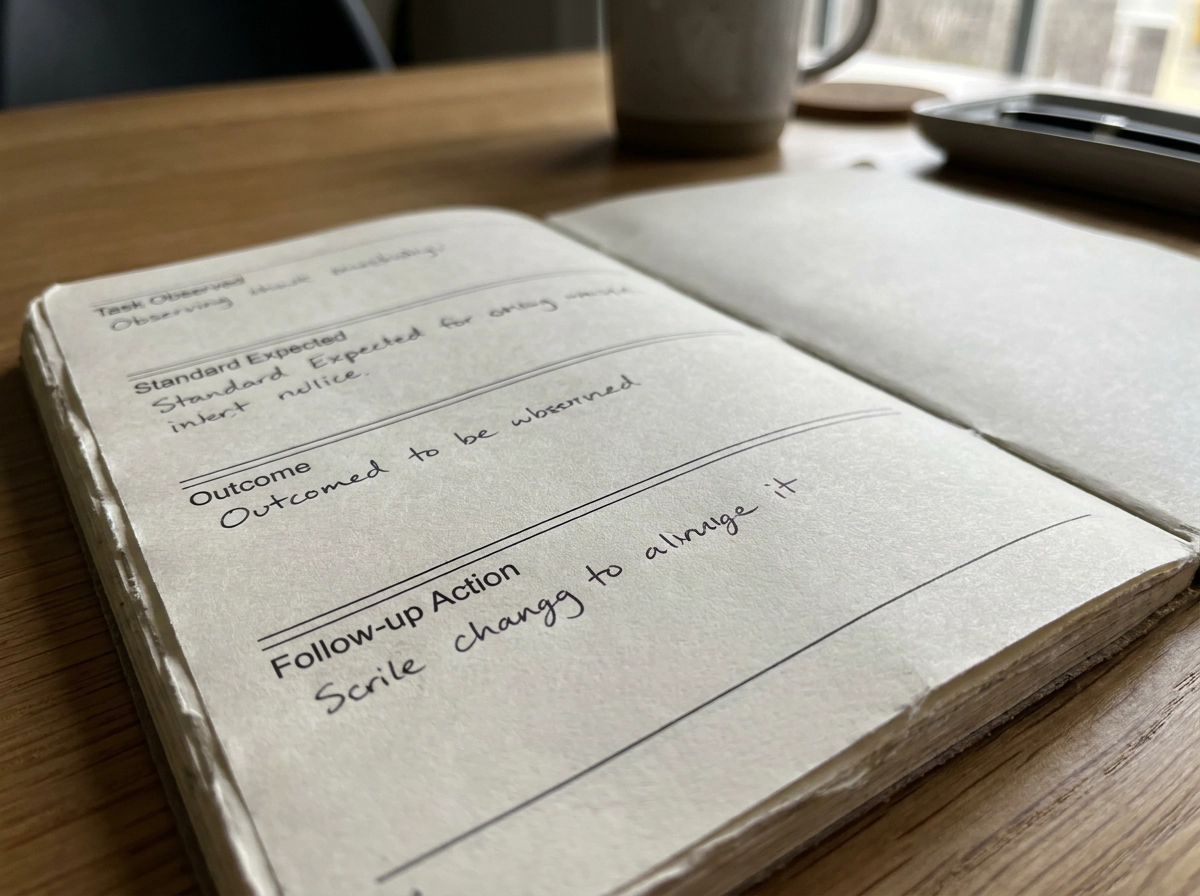
So what shape should that evidence take? Four fields do the work: task observed, standard expected, outcome, follow-up action. Each answers a different question, and together they read as one complete story.
Keep it deliberately short. If an entry can't be written in a few lines, it won't survive a busy week on a care rota. The same four fields work whether the source is a formal supervision, a ten-minute spot check or a note jotted during a shift.
Laid out as a simple table, the format doubles as rehearsal material for a CQC mock inspection template. Managers who practise answering from their own records find the real conversation far easier to hold.
Slot the fields into your existing supervision and appraisal templates rather than maintaining separate documents. Treat it as a suggested improvement, not a mandated one.
Get this field right and the rest of the record almost writes itself. Write the task as the person actually performs it. "Prompting and recording medication for four people on the morning round" tells an inspector far more than "medication".
Note the date and the setting too, because competence is task and context specific. Personal care observed at home says little about pressure area care in a residential setting.
Keep it purely observational, describing what you saw happen rather than what someone told you happens.
Finally, one task per entry. That way, months later, when an inspector asks for a specific example, you can find it in seconds instead of wading through general impressions.
Field one says what you watched. Field two says what you watched it against, and this is where the record stops being your opinion.
Name the source every time: the care plan, the medication policy, the moving and handling guidance, or your own written procedure. "Outcome: good" proves nothing. "Outcome: met step four of the safe handling procedure" is evidence you can be questioned on and still hold up.
Where the person completed training or a learning pathway for that task, name it here. Learning and practice then sit in the same entry, which is exactly what a competency based assessment should show.
Sometimes you will find no written standard exists at all. Treat that as a finding in its own right and give it a follow-up action.
With the standard named, the outcome is where you record honestly what you saw. Use one of four ratings: met, partly met, not met, or not observed today. A clean not met beats a vague satisfactory every time, because it tells you exactly where to act.
Describe what happened rather than judging the person. "Needed two prompts to complete the record" is far more actionable than "struggled".
Positive outcomes matter beyond the individual. Consistent met ratings across a team are evidence of consistent practice, not just individual compliance.
Log near misses with how you responded. That response is proof of a safe, learning culture, which is precisely what inspection conversations probe.
Outcome records what happened. Follow-up action records what happens next, and it is the field that keeps the audit trail alive.
Every entry ends one of two ways: no action required, or an action with a named owner and a date. Vaguer wording, such as "monitor going forward", is where the trail breaks.
Small actions count. A five-minute refresher on recording a fluid balance chart is legitimate follow-up once it is written down.
Close the loop, too. The next supervision should reference the previous follow-up and its outcome. That is what keeps this routine self-sustaining rather than a pile of open actions.
Where a follow-up points to a refresher module, a learning pathway or a competency assessment, myAko lets you action it in a couple of clicks.
Here is how those four fields look in the real world.
Domiciliary care: a care worker prompting medication on a Tuesday morning round. Task observed: the prompt and the record. Standard expected: your medication policy and the person's care plan. Outcome: all four prompts given within the window and recorded at the time. Follow-up action: no action required.
Residential care: a support worker assisting a resident with a hoist. Standard expected: your moving and handling procedure. Outcome: met. Follow-up action: none, with a note that this was their first observed transfer since being newly assessed.
An inspector can check the date, trace the standard and see whether the action was closed. Three descriptive sentences do not let them do any of that. A paragraph of narrative with no standard and no action reads as conscientious but proves nothing.
We suggest a few minutes per staff member. That is an estimate from the shape of the format, not a measured benchmark.
You have the format. Now it needs a home in your diary, or it stays a good idea.
Our suggestion is two staff per fortnight. For a small team, that is full coverage over a few months. Treat the cadence as our suggested routine, not a regulatory requirement.
Slot it against something you already do: supervision slots, handover, a monthly team meeting. Attach it to an existing fixture and it survives a busy week. Create a separate task and it quietly stops.
Rotate deliberately. Cover medication, moving and handling, safeguarding and infection control first, and prioritise new starters and anyone not observed recently.
Capture in the moment, not from memory. Use the four fields while you watch, or jot them on your phone and type them up the same day while the detail is fresh.
At month end, review the fortnight's entries together. Close open actions, look for patterns across the team, and decide what the next fortnight covers.
At month end, gather entries by task and by team member. Coverage becomes obvious: what is well evidenced, who is due an observation, where the gaps are.
Build a simple competency based assessment view: staff down one side, key tasks across the top, a tick in every cell backed by a dated observation. Gaps appear in seconds.
Then rehearse. Ask a colleague to pick two staff at random and challenge you to prove competence, as a CQC mock inspection template exercise would. If the answer does not come quickly, that is your next fortnight's focus.
The four fields map straight onto the columns of a compliance report, so a month of evidence becomes a report without re-reading narrative. Real-Time Reporting speeds that up.
myAkoTQ is built for this: training and quality assurance in one system, so competency assessments, supervisions, appraisals and compliance reporting draw on the same entry rather than separate paper trails. With myAko You Can, see how this works for your service.
The reporting only works if the entries behind it hold up. These six slips quietly undo good work.
Writing for the inspection, not the care. If an entry reads like a performance, rewrite it as what actually happened on shift.
No date, no name. An undated entry proves nothing about the person or the moment, and it is the fastest way to lose credibility when someone asks you to explain it.
Follow-ups with no owner and no date. These are the entries that fail a mock inspection, because nobody can show anything changed.
Trying to observe everything at once. Big first weeks, silence by week four. Narrow the scope, hold the cadence, accept partial coverage in month one.
Two sets of paperwork. Keep the four fields inside the supervision and appraisal templates you already use, not alongside them.
Treating a completed eLearning module as competence evidence. It shows learning, not doing. The four-field record shows doing.
Pick two staff and one high risk task this fortnight, then write the next observation using the four fields: task observed, standard expected, outcome, follow-up action.
Name the standard from a document you already have, such as your medication policy. End the entry with either no action required, or an action with an owner and a date.
Diary the next fortnight now, against a meeting or supervision slot already in your calendar. That single step is what keeps the routine alive.
At month end, count your entries by task and by person. That count is your first compliance report, and your first honest picture of coverage.
If you want the records and the reporting in one place, myAko's competency assessments, supervisions and compliance reporting are built for exactly this. Fancy a proper taste? Free UK based chat and phone support is there if you want a hand setting it up.
Good conversations leave no trace unless you write them down. The four-field record changes that: task observed, standard expected, outcome, follow-up action. It takes ten minutes a fortnight, fits inside the templates you already use, and turns everyday supervision into evidence inspectors can actually see.
Start small. Pick two staff and one high-risk task this fortnight, name your standard from a policy you already have, and diary the next observation before you leave the room. That one habit builds coverage, and by month end your entry count becomes a real compliance report.
You do not need perfect records across every task. You need consistency that survives a busy week.
So pick your two staff today. Write one entry. Then repeat in a fortnight. If myAko can carry the reporting for you, even better. That is how quiet, steady evidence gets built.

Our Learning Management System is used by hundreds of Health & Social care providers - book a demo now!
One of the team is ready to show you how everything works and answer any questions you might have!
Choose a Time Slot
Join Zoom Call
45 Minute Demo
Ask Questions


